|
|
||||||||||||||||||
 |
|
|||||||||||||||||
| Mordechai Vanunu | ||||||||||||||||||
|
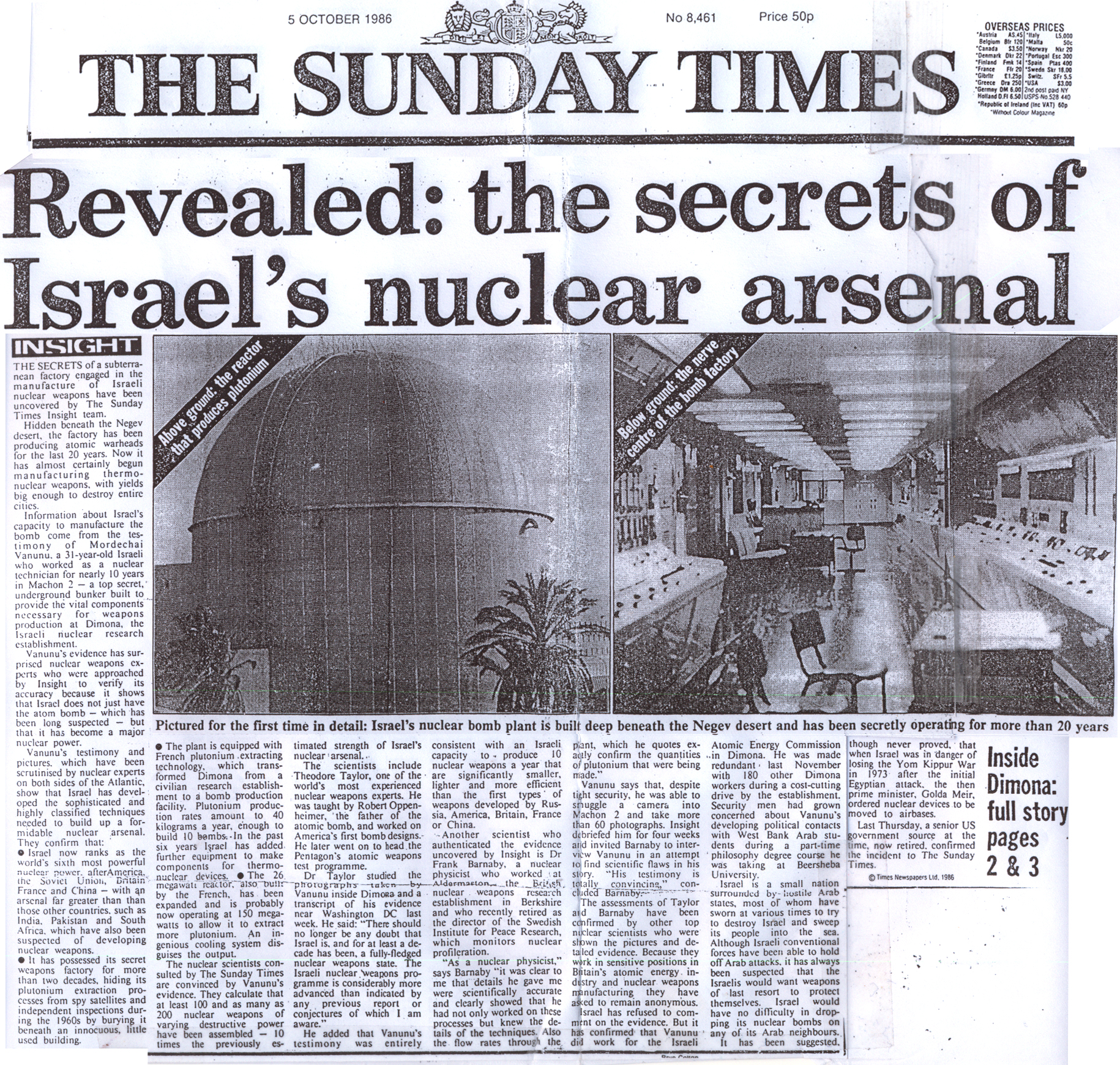
Born on 13 October 1954 in Marrakesh, Morocco, he came to Israel with his family at the age of 9. Mordechai Vanunu was a student at the University of Beersheba, a teaching assistant in philosophy, a music lover, and active in groups seeking rapprochement and understanding between Jews and Arabs. To earn a living, he worked from 1976 to 1985 as a technician at the nuclear reactor in Dimona. Vanunu was a cog in a large machine. Those in charge of him were pleased with him. He carried out his role dedicatedly and efficiently, without asking questions. Over time, to the dismay of the devotees of the nuclear establishment, Vanunu rose above the image of a single cog. This was the beginning of the great rupture. He raised his head, and a terrible picture gradually became clear to him: he was part of a destruction machine. He was taking part in preparing a nuclear holocaust. He began to ask questions: Do the citizens know what is happening behind the walls of the reactor in Dimona? Do they know that Israel is producing atomic bombs in insane quantities? Do they know about the nuclear waste that keeps accumulating and endangers the water sources and the soil? Should the citizens of Israel and of the world not first receive reliable information about what is happening? Should the citizens not be asked for their opinion and consent on a matter that endangers the life of each one of them? Mordechai Vanunu reached the obvious conclusion: in a democratic regime, citizens are entitled to receive information. One of the basic principles of democracy is the public's right to know. Without the realization of this right, they cannot properly fulfil their democratic role as supervisors of the government. How does one pass information to citizens when the government prevents them from receiving it by using its governmental power? What do you do when the Israeli press has no legal possibility, because of the sword of censorship, to publish the information? There is no escape: the citizen Vanunu was forced to outwit the government. In 1986 he managed to smuggle a camera into the reactor, photograph it and take the films abroad. Mordechai Vanunu travelled the world carrying information for which any intelligence agency would pay millions. But he did not seek to spy. He sought to pass information to citizens and, through it, to recruit them to the struggle against nuclear weapons. Vanunu met the editors of one of the most respected newspapers in the democratic world, the Sunday Times, and gave them the information without receiving any payment - purely for the sake of principle. On 5 October 1986 the Sunday Times ran a story that shocked the world: Israel is a nuclear power on a par with France, Britain and China. The story was accompanied by a photograph of the internal structure of the reactor, proving Israel's capacity to produce atomic bombs (for the full article in English, published in 1986, click here - subscription required). Vanunu provided proof that Israel had accumulated hundreds of nuclear bombs in its tiny territory. Israel's nuclear madness exceeds everything that was assumed. Vanunu provided Israeli citizens and the world with the conclusive proof that Israel's official statements on the nuclear issue are false: that the policy of "we will not be the first to bring nuclear weapons into the Middle East" is a sham and a deception. Vanunu finally shattered the Israeli lie that began with the announcement made by Prime Minister David Ben-Gurion in the Knesset in December 1960, that the reactor was meant to be for peaceful research and would be open to scientists from all over the world.
Following Vanunu's revelations, Israel responded like a terrorist state. The rotating Likud-Labor government, led by Shimon Peres (Prime Minister), Yitzhak Rabin (Minister of Defence) and Yitzhak Shamir (Minister of Foreign Affairs and Deputy Prime Minister), decided to send a group of Mossad agents to Europe to kidnap Vanunu. They succeeded in capturing him in Rome, shackled him, injected him with a sedative and took him to a navy ship waiting off the Italian coast. Vanunu vanished and the whole world searched for him. The Israeli government initially denied that Vanunu was in its hands, but when international pressure grew, the government announced that Vanunu was in an Israeli prison. True, Israel has extradition agreements with Italy and Britain, and under international law it would have been obliged to open extradition proceedings if it wanted Mordechai Vanunu. But international law means nothing to Israel. It behaved like one of the Lebanese terrorist organizations that engaged in kidnapping civilians in the 1980s. Once Israel admitted that Vanunu was in its custody, a smear campaign against Mordechai Vanunu began in the press, skillfully orchestrated by the Shin Bet. This was one of the saddest moments in the history of the Israeli press. Newspapers published distorted information that the Shin Bet leaked, without checking and without verification. Vanunu's character was distorted and drawn in lines reminiscent of the reports of the Soviet press in the show trials in Moscow in the 1930s. The press convicted Vanunu long before the trial began - and all of this, let us not forget, because he passed information to the press. Facing this smear campaign stood a handful of sane Israelis, who founded the "Israeli Committee for Mordechai Vanunu and for a Middle East Free of Nuclear, Biological and Chemical Weapons". On 30 November 1991 the committee organized the first demonstration in the history of the State of Israel outside the Dimona reactor, calling for its dismantling and expressing support for Vanunu's act. The 16 Israelis who came to the demonstration faced almost the entire Negev police force - a surreal spectacle that will not be forgotten.
In the members of the group's view, the real criminals who should stand trial are the rulers and the scientists who run the production of atomic weapons behind the backs of the citizens, and the messenger who passed on to the public information about their activity must not be harmed. Mordechai Vanunu revealed himself to the committee members as a man of conscience, an intellectual, an idealist committed to a world free of weapons of mass destruction, who performed a noble act and is paying a heavy price for it. As much as he is hated by Israeli citizens, Vanunu has earned international esteem and recognition. He was awarded the Alternative Nobel Prize, the Danish Peace Prize and other peace prizes, and an honorary doctorate from the University of Tromsø in Norway. Since his imprisonment he has been among the candidates for the Nobel Peace Prize every year. Mordechai Vanunu's trial, held behind closed doors, was a rigged trial whose outcome was known in advance. If the judges had performed their role according to the values of a democratic trial and the principles of human rights, they would have had to cancel the trial as soon as it opened and order his return to Italy, from where he had been abducted in violation of international law. However, the three judges of the Jerusalem District Court, and then the three judges of the Supreme Court who heard the appeal, acted as Shin Bet agents, and his conviction was in accordance with a script written by Shin Bet people even before the trial began. There is no greater absurdity than convicting a person of espionage and treason for passing information to the press. In connection with the trial, it should be emphasized that two of Vanunu's judges, Zvi Tal in the District Court and Dov Levin in the Supreme Court, were also among the panel of judges in the case of John Demjanjuk, who was accused of assisting in the crime of genocide. While they convicted Vanunu because he acted according to the dictates of his conscience and his commitment to save humanity from a nuclear holocaust, they convicted Demjanjuk because he did not act according to the dictates of conscience and did not save people from destruction. The judges did not even sense the contradiction into which they had fallen - perhaps because, in judging Vanunu, they were infected by the syndrome that Hannah Arendt called the banality of evil. Mordechai Vanunu was sentenced to 18 years in prison for an act that almost every journalist performs in the course of their work. If every journalist who published classified information were sent to long prison terms, most of Israel's journalists would have to be in prison. Not only journalists - politicians too. Mordechai Vanunu did not betray or spy. He fulfilled the role of the reprover and the warner, in line with the biblical commandment, "You shall surely rebuke your neighbour" (Leviticus 19:17). The people and its leaders, who are smitten with the nuclear idol, did not want to hear his rebuke, and threw him into the pit, as the rulers of the time did to the prophet Jeremiah. The government of the State of Israel was not satisfied with the draconian punishment of 18 years' imprisonment. The Shin Bet and the Israel Prison Service imposed an additional punishment that did not appear in the sentence at all: imprisonment under conditions of total isolation. The prolonged isolation endangered Vanunu's health. The Shin Bet's justification - that Vanunu had secret information for which he had to be isolated - was baseless. Everything Vanunu knew, he had handed over to the Sunday Times. The story of his kidnapping was also reported in detail around the world, and even inspired several directors who made films about it. What is more: during Vanunu's imprisonment, the locations of Israel's nuclear missile sites were published abroad (in the area of Moshav Zekharya in the Jerusalem hills and near Moshav Yodfat in the Galilee) - information that Vanunu did not have at all. The isolation was carried out with cold calculation, aimed at causing Vanunu to lose his sanity. This is a punishment taken from the school of thought of dictatorial regimes that used to commit political opponents to psychiatric hospitals. The prolonged isolation imposed on Vanunu led to an international campaign demanding an end to the isolation. Nobel Prize laureates, artists, statesmen, members of parliament from New Zealand and Australia, from Japan, from Europe and from the Americas protested his cruel imprisonment. Amnesty International issued a statement determining that the isolation conditions in which Vanunu had been held for years are "cruel, inhuman and degrading". Organizations for Mordechai Vanunu were set up in many countries. Support delegations came to Israel from around the world, met with the President of the State and the Minister of Justice, and demonstrated outside Ashkelon prison for his release. And yet time did not stand still, even in Israel, although it moved slowly. A growing number of students have prepared, and are preparing, academic papers on Mordechai Vanunu and the nuclear issue, and in some of them the reader discovers understanding, even sympathy, for his act. The play "Mr. V" about Mordechai Vanunu, a one-man play written by Yigal Ezrati and starring the actor Yonatan Cherchi, also contributed to a different, more balanced view of the man and his act. The international conference for the human rights of Mordechai Vanunu, chaired by Nobel Peace Prize laureate Prof. Joseph Rotblat and held in Tel Aviv in 1996, on the tenth anniversary of his imprisonment, was the high point of international activity in two areas: support for the man and support for the idea. The ongoing struggle bore fruit when, at the beginning of 1998, after 11.5 years of isolation, the Israeli authorities partially lifted the isolation to which Vanunu had been subjected. On 21 April 2004 Mordechai Vanunu was released from prison after serving the full 18 years of the sentence imposed on him. It was a day of celebration for Vanunu's supporters and for opponents of nuclear weapons alike. Support delegations from abroad and his supporters in Israel gathered outside Ashkelon prison and greeted him with applause. He came out of prison a proud man. The 18 years of imprisonment - more than 11 of them, as recalled, in total isolation - did not break his spirit. He did not regret his act. He came out of prison committed to the idea of dismantling nuclear weapons, just as he had entered 18 years earlier. Since his release he has received another prize, the John Lennon and Yoko Ono Peace Prize. The prize ceremony was held at the UN in New York, and since Mordechai Vanunu could not receive the prize himself, his adoptive parents received it on his behalf. The joy of his release was clouded by a series of restrictions that the Israeli government imposed on Mordechai Vanunu. It appears that the government, through the Shin Bet, could not digest the fact that Vanunu stands by his act and continues to stand behind it despite the cruel conditions of his imprisonment. He was forbidden to leave the country. He is obliged to inform the police of his movements outside his place of residence, may not talk to people from abroad, and may not approach embassies and border crossings. These restrictions are renewed every year, and the formal justification is, of course, "security". The Shin Bet continues to make the absurd claim that Vanunu "stores in his head" secret information, while nuclear experts around the world have given professional opinions that everything he knew he passed to the newspaper in 1986. In his 18 years of imprisonment he was completely cut off from Israel's nuclear industry, and he has no idea what is happening today behind the walls of the Dimona reactor. The Supreme Court has so far approved the restrictions every year, in a legal process that raises questions about its independence from the Shin Bet. In the context of Mordechai Vanunu's petitions to the High Court of Justice against the restrictions, a procedure known as "ex parte" is held, under which the judges lock themselves in a closed room with representatives of the Shin Bet, who feed them "secret material". Vanunu and his lawyers, Avigdor Feldman and Michael Sfard, are not permitted to see the material and cannot challenge or refute it. The judges are "convinced" by the secret material, bow low before the Shin Bet and approve the restrictions. Since his release, Mordechai Vanunu has lived in East Jerusalem. The only way open to him to prove that he has no secret information has been through interviews he gave to the foreign press. True, these interviews were conducted in violation of the restrictions, but through them he proved that he has no secret information at all. The Israeli government decided to put him on trial, but the indictment did not include any clause accusing him of passing on secret information - only the very act of speaking with foreign people, in violation of an order issued by the General Officer Commanding Central Command. The Israeli government reveals its attitude towards Vanunu in all its nakedness: where has it been heard, in a democratic state, that a general forbids a citizen from talking to "foreigners"? This gimmick exists in "the only democracy in the Middle East". The Magistrates' Court, not surprisingly, convicted Vanunu of holding those conversations and sentenced him to six months' imprisonment. An appeal was filed with the District Court, and the hearing is due to resume in January 2008. It is possible that the actual imprisonment will be replaced by a suspended sentence or community service. As long as the restrictions remain in force, Vanunu's release is only partial. He continues to be a prisoner. He cannot live as a free person wherever he wishes and start a new life, start a family, work and live as a free man. Gideon Spiro I am your spy / Mordechai Vanunu (1987)
I am the clerk, the technician, the mechanic, the driver,
|
||||||||||||||||||
|
||||||||||||||||||