|
|
||||||||||||||||||||
|
|
|||||||||||||||||||
| Nuclear missile base Kanaf 2 (Wing 2) | ||||||||||||||||||||
|
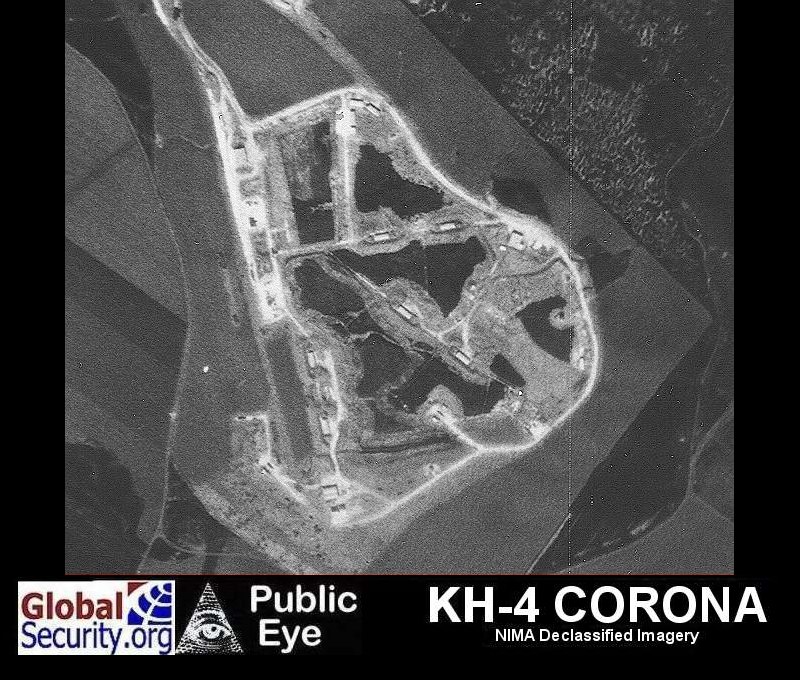
Kanaf 2 (Wing 2), or Sedot Mikha, is the name of the air force base where Israel's Jericho ballistic missiles, which carry nuclear warheads, are located. The base, established after the 1967 war, is near the moshavim Sedot Mikha, Zekharya and Tirosh (not far from Beit Shemesh). The base has underground pits in which the nuclear missiles are readied for launch, as well as storehouses in which additional missiles are kept. Experts at the website Global Security (globalsecurity.org) write that there are two separate bases in this area, Sedot Mikha and Tirosh, but it appears to be the same military base, because the sites are so close together. According to estimates made in 2002 based on photographs from the American military reconnaissance satellite Corona and the commercial satellite IKONOS, there are several dozen pits for nuclear missiles (23-50), up to 30 metres deep in the ground. The area is characterized by soft chalk rock, which makes it relatively easy to dig the pits. Kanaf 2 houses Jericho 1 missiles with a range of up to 500 km and Jericho 2 missiles with a range of up to 1,500 km. By 1980 Israel had invested about a billion dollars in the development and production of the Jericho 1 missile - a missile of which about 50 units were produced. The missile is considered outdated today, and it is not unlikely that some of its systems no longer function (given that more than 20 years have passed since they were manufactured). In a similar case, the United States invested billions of dollars in renewing the engines of ballistic missiles of the same type. In the mid-1980s development and production began on the Jericho 2 missile, which became operational in the early 1990s. According to estimates, at least 50 missiles of this model were produced. Israel is apparently now engaged in developing and producing a new model - the Jericho 3 - which is to reach a range of up to 5,000 km. Information about this has not yet been confirmed. According to a report by an American Congressional research institute, Israel has 50 vehicles carrying Jericho 1 missiles, and 100 Jericho 2 missiles carried on vehicles or on flatbed railway wagons - all stored underground. The transition to Jericho 2 missiles, which took place in the 1990s, required changes to the military base. It is still not clear whether Israel built a new base for the more advanced missiles, replaced the old missiles with new ones, or a third possibility: that the base stores both models. According to an assessment, the trapezoid visible in the photograph above houses the more advanced Jericho 2 missiles.
As noted, the base belongs to the air force, even though it has no runway. Squadrons 150, 199 and 248 operate at the base. It is located at Latitude: 31° 41' 59" N, Longitude: 34° 55' 0" E. In English it is also referred to as Khirbet Zakariya, which lies near the moshav Zekharya. The nuclear missiles are apparently transported to this base by a railway line that connects to the old Jerusalem line running near Nahal Soreq, and which allows a connection with the missile plant at Be'er Ya'akov. Some of the images shown here are old and were taken by the Corona satellite in the early 1970s, more than 35 years ago - images whose classification has been lifted. Google censors the images in which the missile base appears in its Google Earth program, and the images show up blurred or at very low resolution. There are of course many commercial satellites that provide images of every point in Israel, and the images can be bought on the open market. Under pressure from Israel, starting in 1996-97 a special amendment was added to US law that prevents American commercial companies from selling satellite images of Israel (and only of Israel) at a resolution finer than two metres (so that each pixel in the image represents two square metres of area). Since commercial satellites today also provide images at a resolution of half a metre, the images of areas of Israel are blurred. Israel also succeeded in persuading Russia to prevent commercial companies (such as Sovinform Sputnik) from selling satellite images of Israel at a resolution higher than two metres. Sources: All the information was taken from open sources and has been published many times over
|
 |
 |
||||||||||||||||||